

Softener Plant
Overview
Water hardness is one of the most common water quality problems faced by industries, housing societies, hotels and commercial establishments. Hard water contains high concentrations of calcium and magnesium ions that cause scale formation in pipes, boilers, heat exchangers and appliances — leading to reduced efficiency and costly maintenance. Green Nature Solutions supplies domestic and industrial water softener plants that efficiently convert hard water into soft water using the ion exchange process.
How It Works
Water softening is based on the ion exchange principle. Hard water is passed through a bed of strong acid cation exchange resin charged with sodium ions. As water flows through, calcium and magnesium ions in the water are exchanged with sodium ions from the resin. The outlet water is soft and free from hardness-causing ions. When the resin is exhausted, it is regenerated using a sodium chloride (common salt) brine solution, which restores the sodium ions and the resin is ready for the next cycle.
Process Flow
- Service Cycle – Hard water passes through resin bed; Ca²⁺ and Mg²⁺ are exchanged for Na⁺
- Backwash – Upward flow to clean and re-bed the resin
- Brine Draw – Salt solution drawn through the resin for regeneration
- Slow Rinse – Brine displaced through the resin at slow flow
- Fast Rinse – Resin rinsed to remove residual brine
- Service – Unit returns to normal service
Types of Softeners
- Manual Softeners – Operator-initiated regeneration
- Semi-Automatic Softeners – Automated regeneration with manual brine preparation
- Fully Automatic Softeners – Timer or meter-based automatic regeneration with auto brine refill
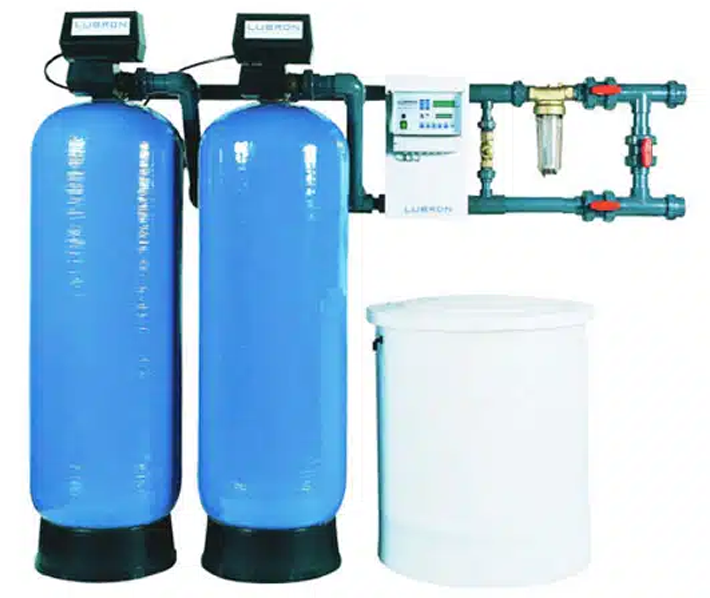
- Duplex / Twin Alternating Softeners – Continuous soft water supply with no interruption during regeneration
Automatic Softener Features
- Quick installation and commissioning
- Automation Grade: Fully automatic
- Available Capacities: 1.0, 2.0, 3.0, 4.0, 5.0 m³/hr and above
- Customisable softener tank type and size
- Multiport valve or individual valve configurations
Applications
- Housing societies, apartments and residential complexes
- Hotels and resorts
- Hospitals and laundries
- Boilers and steam generation systems
- Cooling towers and heat exchangers
- Food and beverage processing
- Textile and dyeing industries
Key Features
- Proven ion exchange technology with long resin life
- Reduces scaling in pipes, geysers and appliances by up to 95%
- Low operating cost — only common salt required for regeneration
- Compact FRP or MS tank design
- Available in simplex and duplex configurations
- Fully automatic models with digital controllers
- Hardness as low as 0–5 ppm in treated water
Technical Specifications
| Parameter | Details |
|---|---|
| Capacity | 0.5 – 100 m³/hr |
| Inlet Hardness | Up to 1500 ppm as CaCO₃ |
| Outlet Hardness | < 5 ppm as CaCO₃ |
| Regenerant | Sodium Chloride (NaCl) |
| Resin Type | Strong acid cation exchange resin |
| Tank MOC | FRP / MS Epoxy Coated / SS |
| Control Valve | Multiport valve / Individual valves |
| Automation | Manual / Semi-auto / Fully automatic |