Preloader Close



Bio Gas Plant
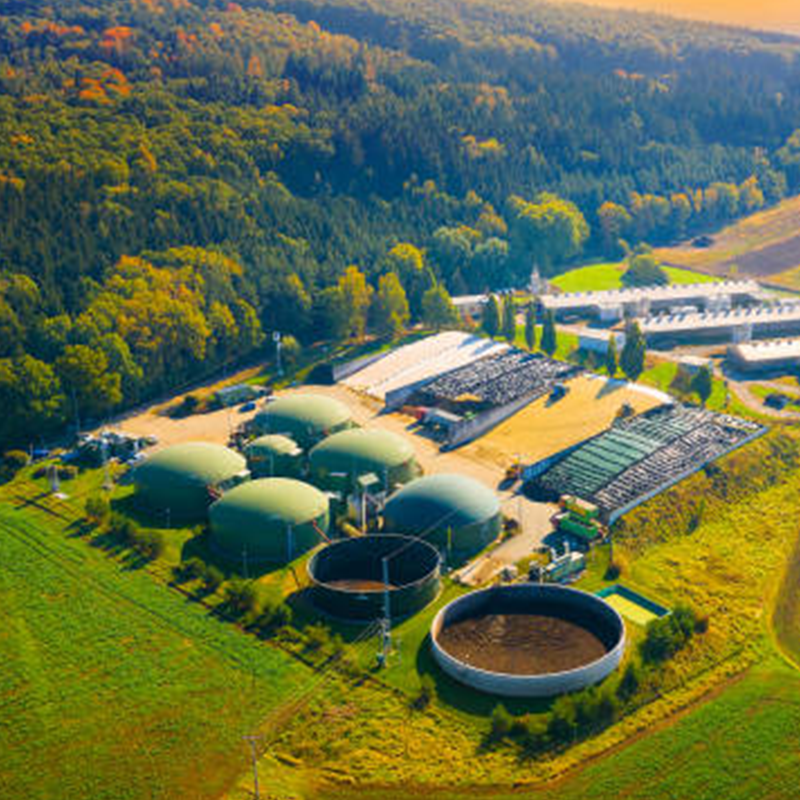
Overview
Biogas plants convert organic waste — food waste, agricultural waste, animal dung, sewage sludge and industrial organic effluent — into biogas (a mixture of methane and CO₂) through anaerobic digestion. GNS designs and installs biogas plants that help organisations reduce waste disposal costs, generate renewable energy and lower their carbon footprint — turning a waste problem into an energy asset.
How Anaerobic Digestion Works
Organic matter is fed into a sealed digester tank in the absence of oxygen. Naturally occurring anaerobic bacteria break down the organic material through four stages — hydrolysis, acidogenesis, acetogenesis and methanogenesis — producing biogas (55–70% methane) and a nutrient-rich digestate slurry that can be used as organic fertiliser.
Process Flow
- Waste Collection & Segregation – Organic waste segregated and shredded if required
- Pre-treatment – Mixing with water to achieve optimal slurry concentration
- Feeding – Slurry fed into the digester via inlet pipe
- Anaerobic Digestion – Bacteria break down organics and generate biogas over 20–40 days
- Biogas Collection – Gas collected in a floating or fixed dome and stored
- Biogas Utilisation – Used for cooking, heating, electricity generation
- Digestate Outlet – Nutrient-rich slurry withdrawn and used as biofertiliser
Biogas Utilisation Options
- Cooking and Heating – Direct use in burners for canteens and kitchens
- Power Generation – Biogas genset for electricity production
- Process Heat – Boiler fuel for industrial process heating
- Compressed Biogas (CBG) – Upgraded and bottled as vehicle fuel (CNG equivalent)
Applications
- Hotels, restaurants, canteens and food courts
- Residential apartments and housing societies
- Vegetable markets and food processing units
- Dairy farms and poultry farms
- Municipal solid waste treatment
- Hospital organic waste management
- Agricultural farms
Key Features
- Converts waste to energy — reduces electricity and LPG costs
- Reduces organic waste volume by 80–90%
- Zero odour emission from properly sealed digester
- Digestate is rich in nitrogen, phosphorus and potassium — excellent biofertiliser
- Low maintenance — no moving parts in the digester
- Reduces greenhouse gas emissions significantly
- Available in fixed dome, floating drum and modular designs
Technical Specifications
| Parameter | Details |
|---|---|
| Feedstock | Food waste, agri waste, animal dung, sludge |
| Digester Type | Fixed dome / Floating drum / CSTR |
| Retention Time | 20 – 40 days |
| Biogas Yield | 0.3–0.5 m³ per kg VS of feedstock |
| Methane Content | 55 – 70% |
| Capacity | 1 m³/day – 500 m³/day |
| Digestate | Nutrient-rich biofertiliser |